Which Brokers Removed the PDT Rule? A Dated Tracker, Broker by Broker
Which brokers removed the PDT rule? We read ten brokers' own pages in September 2026. Eight say the flag is gone. Here's what still limits a small account.
As of 24 September 2026, eight of the ten brokers whose own pages we read say they have dropped pattern-day-trader flagging and the $25,000 minimum: Robinhood, Webull, Public, moomoo, tastytrade, Fidelity, Charles Schwab and ETRADE. Interactive Brokers’ page stops short of saying it has switched over. Merrill’s day-trading article still describes the old rule, and we found no statement from Vanguard. The flag being gone is not the same thing as being free to day trade, though. Three of those eight (Robinhood, Fidelity and ETRADE) state that a $2,000 margin minimum still applies, as does Interactive Brokers; Schwab uses $2,000 as the entry bar for its Intraday Margin Buying Power. And every broker that describes enforcement keeps a margin-deficit call and a restriction for repeat misses.
This page covers only the question of who has implemented the change. For what changed, meaning the FINRA Rule 4210 amendments and how the intraday margin deficit replaces the day-trade count, see our explainer on what replaced the pattern day trader rule. Here’s the one date that matters from that explainer: FINRA Regulatory Notice 26-10 made the change effective June 4, 2026, and gives firms that need more time a phase-in that “Ends October 20, 2027” (re-read at finra.org on 2026-09-23).
The tracker: what each broker’s own page says
Every row below comes from that broker’s own help, learn or support page, read on 2026-09-23 (tastytrade’s on 2026-09-24). None of it comes from a roundup. Where a page is silent, the row says so, and we haven’t filled the gap with a guess.
| Broker | PDT flag / $25K minimum | Date the broker states | $2,000 margin minimum stated? | Source (broker’s own page) |
|---|---|---|---|---|
| Robinhood | “If you had a pattern day trading (PDT) flag or restrictions on your account, they’ll be removed.” | June 4, 2026 | Yes: “the $2,000 margin minimum equity requirement will still apply” | Robinhood Help Center, “Day trading” |
| Webull | “Accounts are not restricted by number of day trades.” “No flag will be triggered.” | “Effective June 4th, 2026” | Not stated on the page read | webull.com/pdt-info |
| Public | “There is no longer a ‘pattern day trader’ designation” | “As of June 4, 2026” | Not stated on the page read | Public FAQ, “What changed with day trading rules?” |
| moomoo | “All existing PDT flags and restrictions have already been removed automatically after June 4 2026.” | Effective June 4, 2026 | Not stated on the page read | moomoo US Help Center, “Intraday Margin Rules” |
| tastytrade | “now have more flexibility to day trade without the $25K minimum or the 3-in-5-day rule” (tastytrade.com/pdt) | “tastytrade was ready for day-1 implementation of the new rule on June 4th, 2026” (tastytrade Learn) | Not stated on the pages read | tastytrade, “PDT” page (tastytrade.com/pdt) and tastytrade Learn, “Pattern day trading” |
| Fidelity | “Existing pattern intraday trading accounts will have any related PDT restrictions and/or calls dropped.” | Rules effective June 4, 2026; no separate Fidelity date | Yes: “Margin accounts will still have a $2,000 minimum equity requirement.” | Fidelity Learning Center, “Intraday trading” |
| Charles Schwab | “As of June 8, Schwab no longer counts day trades in margin accounts.” | June 8, 2026; Intraday Margin Buying Power announced for July 13 | Yes: for Intraday Margin Buying Power, accounts “with at least $2,000 in cash or eligible securities” | Schwab, “Schwab Updates Day Trading and Margin Rules” (dated July 6, 2026) |
| E*TRADE | “E*TRADE implemented these changes on June 9, 2026” | June 9, 2026 | Yes: “$2,000; same as any margin account” | E*TRADE Knowledge Library, “Pattern Day Trader (PDT) Rule Change” |
| Interactive Brokers | “The $25,000 minimum equity requirement for pattern day traders is being removed.” Also: “Your account may still be subject to existing PDT rules during FINRA’s transition period” | No implementation date stated (page last updated June 3, 2026) | Yes: “the standard Reg T $2,000 minimum” | IBKR Guides, “Pattern Day Trader Reset” |
| Merrill | Day-trading article still says a pattern day trader must “hold a minimum of $25,000” | No published position found | n/a | Merrill Edge, “What are the rules for day trading?” |
| Vanguard | No page found that addresses the change | No published position found | n/a | Searched Vanguard’s own domains, 2026-09-23 |
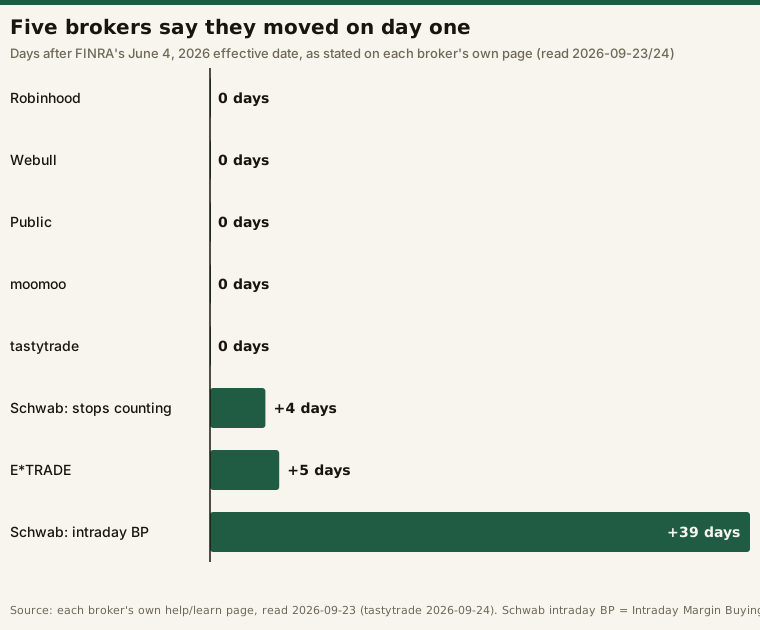
Five of the ten (Robinhood, Webull, Public, moomoo and tastytrade) state June 4, the effective date itself. Schwab and E*TRADE name dates a few days later, and Fidelity cites the rule’s effective date without a separate Fidelity date.
Two rows need a caution. First, the IBKR page predates the effective date, so it may simply be out of date. A cautious page and an unimplemented rule aren’t the same thing. Second, Merrill’s day-trading article still describes the $25,000 requirement; a stale article and an unimplemented rule aren’t the same thing either. In both cases the only way to settle it is to ask the broker, which is the point of the SEC’s investor guidance: “Your brokerage firm might continue operating under the old day trading margin requirements during the transition” (the SEC’s investor.gov, read 2026-09-23).
“The flag is gone” is not “you can day trade freely”
Most coverage of the change stops at the first column. The limits that actually bind a small account are in the other columns, and none of them went away on June 4.
1. The $2,000 margin minimum never moved
Four brokers in the table state it on their own pages (Robinhood, Fidelity, E*TRADE and Interactive Brokers), Schwab uses it as the entry bar for intraday buying power, and FINRA’s investor guidance explains what it means in practice: “$2,000 is the minimum equity required to engage in leveraged trading… You can trade in a margin account with less than $2,000 in equity, but you cannot use leverage.” Under $2,000, the end of the PDT rule gives you no extra intraday buying power at all.
2. Intraday buying power is a house number, and it moves
ETRADE’s page makes the split explicit. The buying power it displays is “based on house excess, which reflects ETRADE’s firm maintenance requirements (these can be higher than regulatory minimums)”. Whether you’re in deficit, though, is measured against “your FINRA excess”. E*TRADE’s own worked example shows the gap between the two:
# Worked example from E*TRADE's PDT rule-change page (read 2026-09-23).
# Illustrative only: it shows the calculation, not any real account.
market_value   = 250 * 400          # MSFT, 250 shares at $400 -> $100,000
finra_req      = 0.25 * market_value  # FINRA 25%  -> $25,000
house_req      = 0.30 * market_value  # house 30%  -> $30,000
equity         = market_value         # no debit balance in the example
finra_excess   = equity - finra_req   # $75,000  <- used to test for an IMD
house_excess   = equity - house_req   # $70,000  <- shown to you as buying power

# A new position whose margin requirement exceeds finra_excess ($75,000)
# creates an intraday margin deficit (IMD) for the amount above it.

# FINRA Notice 26-10's de minimis carve-out from the "practice" standard:
def practice_exempt(deficit, account_equity):
    return deficit <= min(0.05 * account_equity, 1_000)
Schwab’s page adds a leverage detail worth knowing. Intraday Margin Buying Power uses “a default 25% maintenance margin requirement for most stocks”, which “can provide up to four times the buying power intraday”. Positions opened that way that go past overnight buying power “must exit them by the end of the trading day (8 p.m. ET)” or a margin call may follow. That means more room during the session, and a hard deadline at the end of it.
3. Missed deficit calls still lead to a freeze, and each broker counts misses differently
FINRA’s rule sets a floor. If a customer “makes a practice” of failing to meet intraday margin deficits and misses one by the fifth business day, the firm must block new short positions or debit balances “for 90 calendar days”, “or until the intraday margin deficit has been satisfied”. Each broker writes its own version of that on top:
| Broker | Deadline to meet a deficit | What triggers a restriction | Restriction |
|---|---|---|---|
| FINRA Rule 4210 (floor) | Close of business, fifth business day | Making “a practice” of failing to satisfy | 90 calendar days or until the deficit is satisfied, no new short positions or debit balances |
| E*TRADE | “due five days after the issuance date” | “three violations in a rolling 12-month period” | Possible limits on new debit balances or short positions “for 90 days” |
| Interactive Brokers | “as promptly as possible and ideally within 3 business days” | “4 or more occasions within a 12-month period” | “may result in a 90-day trading restriction” |
| Robinhood | Not stated as a number | “Repeated failures to meet requirements” | “further restrictions” (unspecified) |
| Schwab | Not stated as a number | Real-time monitoring “may block trades that would create or increase intraday margin deficits” | Trade blocked before the deficit forms |
That last row shows a difference in method, and FINRA allows it. Schwab’s page says brokerages may “either monitor accounts for margin shortfalls in real time or perform a single end-of-day check”. Under Schwab’s approach, the practical failure is an order that gets rejected. Under an end-of-day approach, it’s a call you have to meet afterwards.
4. Cash accounts are outside the change entirely
The rule change is about margin accounts, and the brokers that address cash accounts say so. moomoo: “IML rules apply to margin accounts only. Cash accounts continue to follow standard cash trading and settlement rules.” Public: “Cash accounts are not subject to margin rules.” Webull’s help page “Margin & Cash Account: Key Differences” still says that in a cash account “Using unsettled funds to day trade may trigger a Good Faith Violation (GFV)”. Regulation T’s freeriding rule hasn’t changed either. Investor.gov says buying and selling before paying “may require the investor’s broker to ‘freeze’ the investor’s cash account for 90 days.” A small cash account was never subject to the PDT count. Its limit is settlement, and settlement rules didn’t change.
How to check your own broker in five minutes
The only answer that applies to your account is your broker’s, so the method matters more than any row above. We use the same sourcing standard as in how we test tools:
- Find the broker’s own page on the change, usually in the help centre under “day trading” or “intraday margin”. A news story or roundup doesn’t count.
- Check the date on the page against June 4, 2026. A page dated before then (like IBKR’s) may describe plans rather than what’s live.
- Look for the three numbers that still bind: the margin minimum, the deadline for meeting a deficit, and how many misses trigger a restriction.
- If the page is silent, ask support and get it in writing.
Frequently asked questions
Which brokers have removed the PDT rule?
On their own pages, read 2026-09-23 and 2026-09-24: Robinhood, Webull, Public, moomoo, tastytrade (June 4, 2026), Fidelity, Charles Schwab (day-trade counting stopped June 8, 2026) and E*TRADE (June 9, 2026). Interactive Brokers says the $25,000 minimum “is being removed” but gives no implementation date. Merrill’s day-trading article still describes the old rule, and we found no statement from Vanguard.
Can my broker still flag me as a pattern day trader in 2026?
Possibly, if it’s still in FINRA’s phase-in period. Notice 26-10 gives members “that need more time to implement the rule change” a phase-in that ends October 20, 2027, and the SEC’s investor.gov notes that a firm “might continue operating under the old day trading margin requirements during the transition”. Ask your broker which regime your account is on.
Do I still need $2,000 to day trade on margin?
Robinhood, Fidelity, E*TRADE and Interactive Brokers all state a $2,000 minimum on their own pages, and Schwab’s intraday buying power requires at least $2,000 in cash or eligible securities. FINRA’s investor guidance says that below $2,000 you can still trade in a margin account, but without leverage.
Does the PDT change affect cash accounts?
No. The change is to margin rules. moomoo and Public both say on their own pages that cash accounts aren’t covered by the new intraday margin rules. Cash accounts still follow settlement rules, including good-faith violations and Regulation T’s 90-day freeriding freeze.
What happens if I don’t meet an intraday margin deficit call?
That depends on the broker. E*TRADE gives five days and may restrict an account for 90 days after three violations in 12 months. Interactive Brokers says four or more misses in 12 months may bring a 90-day restriction. FINRA’s floor is a block on new debit balances or short positions for customers who make a practice of missing them, lasting 90 calendar days or until the deficit is satisfied.
Sources read 23 September 2026 (tastytrade 24 September 2026), all first-party: FINRA Regulatory Notice 26-10 and FINRA’s investor insight “Understanding the New Intraday Margin Requirements” (finra.org); the SEC’s investor.gov glossary entries “Pattern Day Trader” and “Freeriding”; and each broker’s own page named in the tracker table (tastytrade: tastytrade.com/pdt and its Learn page). All quoted language is from those pages. Broker implementation is changing throughout the phase-in, so check the date above before relying on any row.
This is educational content, not financial, legal or tax advice. We have no affiliate or commercial relationship with any broker named here, and nothing on this page is a recommendation to open an account with, or trade through, any of them.