Best Options Data API? What You're Actually Buying at Each Price
The best options data API depends on what you're buying: recorded quotes, pre-computed analytics, or metered feeds. Four vendors' tiers, read 24 Sep 2026.
The best options data API is the one that sells the thing your question needs. That’s rarely the cheapest plan or the one with the longest feature list. The main vendors sell four different products: recorded bid/ask quotes you build a pipeline around (ThetaData), cleaned and pre-computed analytics (ORATS), a flat-rate multi-asset API that reserves historical quotes for its top options tier (Massive, formerly Polygon.io), and institutional feeds with per-dataset plans billed by usage or licence (Databento). Work out which of those you need first. The price follows from that.
Every price and tier below was read from the vendor’s own pricing page on 24 September 2026. Vendors change these pages without telling anyone who has written about them, so check again before you subscribe. Tradier and Intrinio also come up in this category. We didn’t verify their pages this session, so they’re left out rather than guessed at.
The four products hiding under one keyword
| Vendor | Entry paid options plan | What you’re actually buying | History on the entry plan | Where recorded quotes start |
|---|---|---|---|---|
| Massive (formerly Polygon.io) | Options Starter, $29/mo | A multi-asset REST/websocket API with aggregates, greeks and snapshots | 2 years, 15-minute delayed | Options Advanced, $199/mo |
| ThetaData | Options Value, $40/mo | Raw recorded market data served through a local Terminal | 4 years, 1-minute intervals | Options Standard, $80/mo |
| ORATS | Delayed Data API, $199/mo | End-of-day and intraday data with its own smoothed values, greeks and indicators attached | End-of-day back to 2007, 15-minute delayed | Not sold as a raw quote history. It’s a cleaned snapshot (see below) |
| Databento | Standard, $199/mo (OPRA plan) | Institutional-format OPRA feeds, priced per dataset | 1 year of L1 history | L1 is top-of-book, so from Standard, or pay-as-you-go |
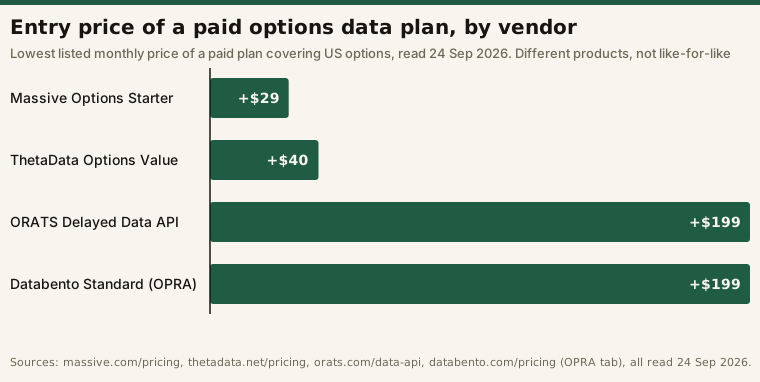
The chart shows why a single “cheapest options API” ranking misleads. The $29 plan and the $199 plans aren’t competing for the same buyer. Each price is the entry point to a different product.
Recorded quotes: ThetaData
ThetaData’s pricing page lists three retail options plans: Options Value at $40/month (4 years of data, 1-minute intervals), Options Standard at $80/month (8 years, tick level) and Options Pro at $160/month (12 years, tick level). All three list unlimited requests and real-time access. The line that matters appears from Standard up: “Every NBBO quote reported by OPRA.”
That’s the product. If your research question includes the word “fill”, you need both sides of the quote at the moment you would have traded. A last-traded price or a model price can’t give you that. We’ve used ThetaData’s NBBO history for our own options backtests. On one QQQ spread configuration, pricing the same trades at the mid and then at the bid/ask turned a profitable result into a losing one. The parameters and the SPY follow-up are in options backtest fill assumptions. That work dates from June 2026. The single-vendor verdict, including the pipeline you have to build around the Terminal, is in our ThetaData review.
A flat-rate API that gates quotes: Massive (formerly Polygon.io)
Polygon.io’s pricing URL now returns a permanent redirect (HTTP 301) to massive.com/pricing, so older comparisons that name “Polygon” are describing this ladder. Its options tab, read on 24 September 2026, lists four personal-licence plans:
| Plan | Price | Data timing | History | API calls | Greeks | Trades | Quotes |
|---|---|---|---|---|---|---|---|
| Options Basic | $0 | End of day | 2 years | 5 per minute | No | No | No |
| Options Starter | $29/mo | 15-minute delayed | 2 years | Unlimited | Yes | No | No |
| Options Developer | $79/mo | 15-minute delayed | 4 years | Unlimited | Yes | Yes | No |
| Options Advanced | $199/mo | Real-time | 5+ years | Unlimited | Yes | Yes | Yes |
The pattern is the opposite of ThetaData’s. At Massive, the step up to the top tier buys quotes and real-time timing, not much more history: Advanced lists “5+” years against Developer’s 4. If your backtest prices fills from the bid and ask, the $29 and $79 plans can’t answer your question at all, however cheap they look.
Cleaned analytics: ORATS
ORATS sells something different from raw data. Its data API page describes end-of-day options data “back to 2007 augmented with hundreds of proprietary indicators.” (The page’s line about prints carrying “delta, gamma, implied volatility, and the underlying stock price” describes its Time & Sales data, which is sold as an add-on, not the end-of-day product.) The plans:
| Plan | Price | Requests/month | Timing | History |
|---|---|---|---|---|
| Delayed Data API | $199/mo | 20,000 | 15-minute delayed | End-of-day back to 2007 |
| Live Data API | $299/mo | 100,000 | Live (data agreements required) | End-of-day back to 2007 |
| Live Intraday API | $599/mo | 1,000,000 | Live, minute-level | Plus one-minute history back to August 2020 |
| All-In API | $899/mo (shown against a struck-through $1,395) | 1,000,000 | All endpoints | Plus Time & Sales from 9 September 2022 |
The detail backtesters most need is in the methodology line. ORATS’s end-of-day data is “Gathered 14 minutes before the close to avoid wide spreads. Cleaned using our Smoothed Market Values system.” That’s a reasonable engineering choice, but it means an ORATS end-of-day snapshot isn’t the closing quote, and a smoothed value isn’t a price anyone quoted. For volatility research and screening, that cleaning is what you’re paying for. If you’re asking “could I have been filled at the close?”, it changes the question you’re actually answering. You need to know which of the two you’re doing.
Metered institutional feeds: Databento
Databento prices each dataset on its own tab, and the OPRA (US equity options) tab lists its own plans: a usage-based pay-as-you-go option with no subscription, Standard at $199/month with 1 year of L1 history, Plus at $1,500/month in licence fees with 3 years of L1 history, and Unlimited at $4,000/month with 13+ years of L1 history. The OPRA view lists L0 and L1 data only. The L2/L3 history lines and the higher Plus and Unlimited prices you may see quoted elsewhere belong to Databento’s CME tab, not to options.
The billing terms decide whether metered data punishes experimentation, and they depend on how you pull the data. Databento’s FAQ says: “When you stream historical or live data, you are billed for every outbound byte.” Batch downloads work differently: the request is “only billed once for the request. You can download the data as many times as you want over 30 days.” So if you stream history, every re-pull costs again. If you request it as a batch download, the cost comes from the size of that request, and re-downloading it within 30 days doesn’t add to it. Use batch downloads for backtest data and scope each request tightly (symbols, dates, schema).
Price per year of history, inside each ladder
When a ladder mainly sells history, dividing price by years shows what each step actually buys. The comparison below only makes sense within a ladder, not across vendors, because the products differ:
# Illustrative arithmetic on list prices read 24 Sep 2026; "5+" years taken as 5.
ladders = {
    "ThetaData": [("Options Value", 40, 4), ("Options Standard", 80, 8), ("Options Pro", 160, 12)],
    "Massive":   [("Options Starter", 29, 2), ("Options Developer", 79, 4), ("Options Advanced", 199, 5)],
}
for vendor, tiers in ladders.items():
    for name, price, years in tiers:
        print(f"{vendor:10s} {name:18s} ${price:>4}/mo  {years:>2} yrs  "
              f"${price / years:6.2f} per year of history")

# ThetaData  Options Value      $  40/mo   4 yrs  $ 10.00 per year of history
# ThetaData  Options Standard   $  80/mo   8 yrs  $ 10.00 per year of history
# ThetaData  Options Pro        $ 160/mo  12 yrs  $ 13.33 per year of history
# Massive    Options Starter    $  29/mo   2 yrs  $ 14.50 per year of history
# Massive    Options Developer  $  79/mo   4 yrs  $ 19.75 per year of history
# Massive    Options Advanced   $ 199/mo   5 yrs  $ 39.80 per year of history
ThetaData’s price per year stays roughly flat up its ladder, which fits a product sold mainly on depth. Massive’s roughly doubles at the top step because that step isn’t selling years. It’s selling quotes and real-time data. Neither figure tells you which vendor is better value. It tells you what each price increase is for.
How to choose
- Write the question before you shop. “Would this spread have filled at the mid?” needs recorded bid/ask quotes. “How does implied volatility behave before earnings?” is well served by cleaned analytics. “Which strikes are trading right now?” needs real-time data.
- Find the cheapest tier that has the data type, then check the history. The data type rules out tiers before price does. If quotes are only on the top tier, the lower tiers aren’t cheaper options, they’re a different product.
- Check the timestamp convention. A snapshot taken before the close, a cleaned or smoothed value and a recorded NBBO quote give three different answers to “what was the price?”.
- Budget for the build. Raw data needs storage, caching and reconciliation that you have to write. Analytics products save that work because the vendor has already made those choices for you.
- Run the test with the least flattering assumption. Better data makes a fill assumption measurable. It doesn’t remove it. That discipline is in how we validate a strategy.
Frequently asked questions
What is the cheapest options data API?
Of the four vendors read on 24 September 2026, Massive’s Options Starter at $29/month was the cheapest paid plan, and it also lists a $0 end-of-day tier. Neither includes historical quotes. The cheapest listed plan with recorded NBBO quotes was ThetaData Options Standard at $80/month.
Is Polygon.io the same as Massive?
As of 24 September 2026, polygon.io/pricing returns a permanent (301) redirect to massive.com/pricing, and the options plans there are the ones described above. Comparisons that name Polygon.io are describing this ladder.
Do I need tick-level options data for backtesting?
Only if your fills or signals depend on what happened inside the day. End-of-day bid/ask quotes are enough to test mid versus taker pricing on a daily-entry strategy, and that’s how our own spread research was priced. Tick data matters for intraday entries and execution studies.
Is ORATS data the same as raw market quotes?
No. ORATS describes its end-of-day data as gathered 14 minutes before the close and cleaned with its Smoothed Market Values system. That’s valuable for volatility analysis, but it’s a processed product, not the recorded closing quote.
Does this site earn money from any of these vendors?
No. This site has no affiliate relationship with any of the four, and nothing on this page pays us if you subscribe.