TradingView's Invite-Only Indicator Marketplace Rule: What Happens to Access You Already Bought
From 1 November 2026, paid TradingView invite-only indicators can be sold only on its Marketplace. What buyers keep, what ends, and what to ask vendors.
From 1 November 2026, TradingView’s Terms of Use allow paid access to invite-only scripts only through TradingView’s own Marketplace. If you paid a vendor outside TradingView before then, TradingView says you can keep using that access “for the period already purchased, including lifetime access”. After that, though, the vendor can’t take another payment outside the Marketplace to renew it, and vendors who keep doing so without contacting TradingView “will have their invite-only scripts blocked.”
So the risk to a buyer is mostly what the vendor does next. Everything below was read off TradingView’s own pages on 13 October 2026. This is a review of published documents, not legal advice, and where those pages disagree, this page says so.
What TradingView announced
The announcement is a TradingView blog post titled “Commercial scripts are moving to the TradingView Marketplace,” published on 30 September 2026. The page’s metadata shows it was last modified on 12 October 2026. Its core paragraph:
“We’ve updated our Terms of Use to clarify how invite-only scripts may be used. Authors can continue to use them for non-commercial purposes without any changes. However, selling access to an invite-only script, or providing that access as part of another paid product or service, will no longer be permitted starting November 1, 2026.”
The rule itself is Section 23 of the Terms of Use, “Prohibition on commercial use of invite-only scripts.” Its definition of commercial use includes any “fee, subscription, donation, or other payment or benefit of monetary value (including tips, gifts, or cryptocurrency)” charged for access, and any use of a script or profile “to advertise or direct users to a paid product or service … including a paid signal service, paid community, paid course, or brokerage or exchange referral program.” It ends: “Scripts available for Commercial Use are only permitted to be distributed via the Marketplace.”
| Date | What happens | TradingView source |
|---|---|---|
| 30 Sep 2026 | Announcement published | Blog post (page metadata) |
| 12 Oct 2026 | Announcement last modified | Blog post (page metadata) |
| Before 1 Nov 2026 | Vendors who want to keep selling contact creators@tradingview.com | Blog post |
| 1 Nov 2026 | Selling or bundling invite-only access outside the Marketplace ends | Blog post; Terms of Use §23 |
What happens to what you’ve already paid for
Each row quotes the TradingView page it comes from:
| Your situation | What TradingView says | Source |
|---|---|---|
| Lifetime access bought from a vendor outside TradingView before 1 Nov | Customers “can keep using it for the period already purchased, including lifetime access” | Blog post |
| Monthly or annual access paid to the vendor directly before 1 Nov | Access runs for the period already paid. After that, “vendors may not take new payments outside the Marketplace to renew, extend, or maintain access” | Blog post |
| Access included with a paid course, Discord, community or signal service | “Providing that access as part of another paid product or service” ends 1 Nov; §23 names paid communities, courses and signal services | Blog post; Terms §23 |
| Free invite-only access, nothing paid | “Authors can continue to use them for non-commercial purposes without any changes” | Blog post |
| A Paid Space subscription bought on the Marketplace | Already the permitted channel | Terms §23 |
There’s one gap, and it matters most to lifetime buyers. Vendors who keep billing outside the Marketplace without contacting TradingView get their invite-only scripts blocked, and Section 23 lets TradingView block “all invite-only scripts published by or accessible to that user.” Neither page says what happens to a paying customer’s access when that happens. Preserved lifetime access is only as safe as the vendor’s compliance.
Section 23 also covers how a script is used, not just how it’s sold. It includes a script “used as, or on behalf of, a company, partnership, trust, or other business or legal entity, or otherwise in the course of a trade or business (including as a sole proprietor).” If you trade through a business, ask TradingView how that applies; this page doesn’t interpret it.
The Marketplace terms describe monthly subscriptions only
The Creator Program terms describe only monthly billing. They define a Paid Space as scripts “offered by an Author for a monthly fee” and a subscription as “a paid, recurring monthly access plan”. They describe no annual or lifetime option. Three more lines matter to a buyer:
- “Subscriptions are billed monthly, following the same rules as TradingView plan payments.” Our auto-renew and refund guide covers what TradingView’s pages say those rules are, including where two of them disagree.
- “If an Author changes the subscription price, the new price applies to existing Subscribers from their next billing cycle. Prices are not grandfathered for existing Subscribers.”
- If an author leaves the program or is removed from it: “Upon termination, active subscribers will retain access until their billing period ends, after which access will be automatically revoked.”
So if your annual plan ends after 1 November and your vendor moves to the Marketplace, the terms as written offer only a monthly renewal at the Marketplace price then. The blog does say vendors will discuss “your transition period” and “how to handle your existing customers” with TradingView, so a different arrangement may exist, but you’ll only learn of it from the vendor.
What a Marketplace subscription costs and how it works
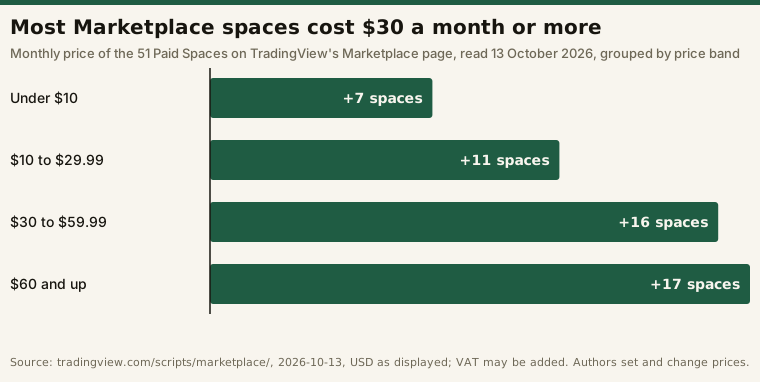
On 13 October 2026, TradingView’s Marketplace page listed 51 Paid Spaces, each priced per month:
| Marketplace listing, 13 Oct 2026 | Value |
|---|---|
| Paid Spaces listed | 51 |
| Lowest monthly price | $4.99 |
| Median monthly price | $43.75 |
| Highest monthly price | $199.00 |
| Spaces at $30/month or more | 33 of 51 |
Here’s the calculation, with every listed price (USD, as displayed) included so you can re-run it:
# Monthly USD prices of the 51 Paid Spaces on tradingview.com/scripts/marketplace/,
# in page order, as displayed on 13 October 2026. Authors change these at will.
import statistics
prices = [29.99, 5.00, 11.00, 5.00, 65.57, 19.99, 10.80, 120.00, 69.00, 49.99,
          63.00, 95.20, 29.99, 59.00, 117.00, 50.00, 9.99, 66.47, 49.99, 4.99,
          39.99, 43.75, 35.00, 73.50, 49.99, 69.00, 18.00, 199.00, 48.88, 35.00,
          40.00, 69.99, 34.50, 99.00, 19.00, 39.99, 120.00, 8.49, 33.00, 79.99,
          9.99, 49.00, 199.00, 19.99, 6.25, 69.99, 14.99, 55.00, 29.99, 25.00, 89.00]
bands = {"under $10": (0, 10), "$10-29.99": (10, 30), "$30-59.99": (30, 60), "$60+": (60, 1e9)}
print(len(prices), min(prices), statistics.median(prices), max(prices))  # 51 4.99 43.75 199.0
print({k: sum(lo <= p < hi for p in prices) for k, (lo, hi) in bands.items()})
# {'under $10': 7, '$10-29.99': 11, '$30-59.99': 16, '$60+': 17}
These are the authors’ own prices, not a forecast of what your vendor will charge. The Creator Program terms set the buyer-side mechanics:
- You don’t need a paid TradingView plan: “Free and paid TradingView users can subscribe.”
- Web only for now: “Subscribing to Paid Spaces is currently available only on the web version of TradingView.”
- Cancel any time: “Users may cancel at any time in account settings. Access remains active until the end of the billing period.”
- TradingView bills you, and its terms win: “All billing, access, and renewals are managed automatically by TradingView,” and if an author’s own terms conflict, “these Program Terms prevail.”
The seller side (eligibility, plan requirements, payouts) is in our Creator Program breakdown.
How to tell whether your script is on the Marketplace
Three checks, based on TradingView’s own description of the two kinds of access:
- How you got access. The Vendor Requirements say Paid Space subscribers “automatically receive access to all the scripts you included in that space.” For a typical invite-only script, the author must “manually grant access to users who request it by using the ‘Manage access’ dialog box.” If you paid on a website and the vendor then added your username, the rule change affects you.
- Who bills you. A Marketplace subscription is billed by TradingView and cancelled in your TradingView account settings. A receipt from the vendor’s own site or payment processor means the purchase was made outside the Marketplace.
- The address. Paid Spaces live at
tradingview.com/scripts/marketplace/<author-username>/. On 13 October 2026,/scripts/marketplace/ChartPrime/loaded that author’s Paid Space, while the same address for TradingView’s own account, which has no Paid Space, returned a 404.
Questions to ask your vendor before 1 November
- Have you contacted creators@tradingview.com about joining the Marketplace, and did TradingView give you a transition period? That’s the route the announcement gives vendors who want to keep selling.
- Will my access move to a Paid Space, at what monthly price?
- I paid for lifetime or annual access. How will you honor it after 1 November, and how will you keep your scripts from being blocked?
- If my access came with a course or community, which parts continue after 1 November?
- If your scripts are blocked, what happens to what I’ve already paid? TradingView’s pages don’t say.
TradingView’s invite-only scripts guide adds pre-purchase questions of its own, such as “Does the author offer a trial period?”
Where TradingView’s own pages disagree
Two undated pages still describe the model that Section 23 ends. On 13 October 2026, the Vendor Requirements still counted anyone who “independently offer[s] access to invite-only scripts” as a vendor and let authors “mention the price of your script” in the Author’s instructions field alongside “a link to your webpage where users can request access.” The House Rules still say: “If you provide paid access to scripts or sell services/products to traders outside the TradingView platform, then you are considered a Vendor.”
Neither page is wrong yet, since the cutoff is 1 November, but a buyer reading only these would think buying access from a vendor’s website is a supported arrangement. Rely on the two dated sources instead: the Terms of Use, Section 23, and the 30 September announcement.
Frequently asked questions
Will my TradingView invite-only indicator stop working on 1 November?
Not automatically. TradingView says customers who paid before 1 November 2026 “can keep using it for the period already purchased, including lifetime access.” The risk is a vendor who keeps billing outside the Marketplace without contacting TradingView: its scripts get blocked, and TradingView doesn’t say what happens to customers’ access then.
Do I keep lifetime access I bought before the cutoff?
TradingView’s announcement says yes: purchased periods are preserved, “including lifetime access,” as long as the vendor’s scripts aren’t blocked. The Marketplace’s own terms describe only monthly subscriptions, with no lifetime option.
Can my vendor still bill me through their own website after 1 November?
Not under the published rules. From that date, “vendors may not take new payments outside the Marketplace to renew, extend, or maintain access to invite-only scripts,” per TradingView’s 30 September 2026 announcement. The same post mentions a “transition period” for vendors who contact TradingView without saying what it allows, so ask your vendor whether it has one.
Do I need a paid TradingView plan to subscribe to a Paid Space?
No. The Creator Program terms state that “Free and paid TradingView users can subscribe.” Subscribing is currently web-only, and subscriptions are billed monthly. Authors need a Premium or Ultimate plan; buyers don’t.
How do I know if a script is sold on the TradingView Marketplace?
If TradingView bills you and access came with a Paid Space subscription, it’s on the Marketplace. If you paid the vendor directly and they added your username by hand, it isn’t.
This is educational content about a platform’s published terms, not legal, tax or financial advice, and nothing here is a recommendation to buy any script or subscription. Everything above was read from TradingView’s pages on 13 October 2026, and those pages can change without notice.