AI Trading Journal: What It Can Grade and What It Can't
An AI trading journal can grade what's already in your record, like tags, patterns and stats, but not reasoning you never wrote down. AI prices compared.
An AI trading journal is good at grading the record you already have. It tags trades, finds patterns across executions, and summarises a session faster than you could. It can’t grade a decision you never wrote down, and the most valuable part of a journal is exactly that: the reasoning recorded before the outcome was known. Buy the AI for analysis. Don’t expect it to do your journaling for you.
The rest of this page sets out where that line falls. It also lists what the main vendors charge for their AI features, read from each vendor’s own pricing page on 2026-10-01.
What a journal is for, and where AI fits
As our journaling guide argues, a journal exists so you can tell a good decision from a lucky one. That only works if the plan, the setup and your conviction were written down at entry, before the P&L could rewrite your memory of them.
That splits a journal into two halves:
| Part of the record | Who writes it | Can AI produce it? |
|---|---|---|
| Executions, prices, sizes, timestamps | Your broker, via import | Not needed: it’s already data |
| Tags such as setup, session and instrument | You, or an auto-tagger | Partly. It can infer them from the data |
| Stats like win rate by tag, hold time and exit efficiency | Software | Yes. This is where AI genuinely helps |
| Your plan, thesis and conviction at entry | Only you, only before the outcome | No |
| Whether you followed your own rules | You, checked against the plan | Only if the plan was recorded |
The top three rows are analysis. AI makes them faster and sometimes deeper. The bottom two rows are the journal itself, and no model can fill them in afterwards without inventing them. An auto-tagger looking at a closed trade only sees the outcome. Any “reason” it assigns is inferred from data that already includes the result.
What AI journals can genuinely grade
When the record is complete, three jobs are real gains.
Pattern-finding across many trades. Pulling out what your losing Tuesdays have in common, or how a setup performs by time of day, is tedious by hand and quick for software. It’s still descriptive statistics. A pattern across a few dozen trades is a hypothesis, not an edge.
Consistency of tagging. If tags are applied the same way every time, a filter on them means something. An auto-tagger is consistent by construction. Whether its categories match your own is something you have to check, the same way you’d read the filters an AI stock screener builds before trusting its list.
Summaries and session reviews. Turning a day of executions into a readable recap saves time. The recap can only be as good as what was imported, and import fidelity varies by broker and asset type. Spot-check the imported numbers against your broker statement before relying on any summary built from them.
What it can’t grade
- A decision you didn’t record. If the plan wasn’t written at entry, the AI has nothing to compare your actions against. It can tell you what happened. It can’t tell you whether that’s what you meant to do.
- Whether a stat means anything. A win rate by tag doesn’t come with a sample-size warning unless the vendor adds one. A pattern found by searching many tags for a good-looking one is the same overfitting trap as tweaking a screen until the list looks good.
- Your circumstances. A coaching layer that says “cut your losers sooner” is a generic rule applied to your data. It knows nothing about your account, your goals or your risk tolerance, and it’s not personal advice, whatever the interface implies.
What the vendors charge for AI
Everything below was read on each vendor’s own pricing page on 2026-10-01. Prices change, so check the live page before you buy. TraderSync’s pricing page returned HTTP 403 to our checks again this session, so it has no prices here. We won’t quote a vendor’s prices from a competitor’s comparison page, and the top-ranking TradeZella-vs-TraderSync comparisons are published by TradeZella.
| Vendor | Plan read | Price (basis as stated) | AI features named on the pricing page | Trial / free tier on the page |
|---|---|---|---|---|
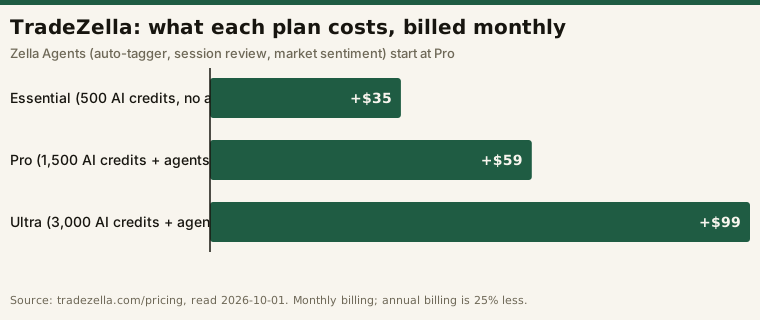
| TradeZella | Essential | $35/mo monthly; $315/yr annual | Zella AI, 500 AI credits/month, AI review reports; no Zella Agents | No trial mentioned |
| TradeZella | Pro | $59/mo monthly; $531/yr annual | 1,500 AI credits/month, Zella Agents included | No trial mentioned |
| TradeZella | Ultra | $99/mo monthly; $891/yr annual | 3,000 AI credits/month, Zella Agents included | No trial mentioned |
| TradesViz | Pro | $19.99/mo monthly; $14.99/mo billed annually | Advertises AI Q&A, AI Coach and AI-powered statistics widgets | Free plan (3,000 executions/month); 7-day trial on paid plans |
| TradesViz | Platinum | $29.99/mo monthly; $22.49/mo billed annually | As above, plus Platinum-only exit analysis | 7-day trial |
| Edgewonk | 1 year plan | $197 per 12 months | “Edge Finder”, described as automatically scanning your journal | 14-day money-back guarantee |
| Tradervue | Silver / Gold | $29.95/mo / $49.95/mo | No AI feature named on the pricing page | Free plan; trial on Silver/Gold that auto-charges |
TradeZella names three Zella Agents on Pro and Ultra: a Trade Auto-Tagger, Session Review, and a Market Sentiment agent. TradesViz also sells REST API and hosted MCP access on Pro and Platinum (not Basic), so you can point an outside AI assistant at your own journal data instead of relying on its built-in AI.
Check the billing basis before comparing
Monthly and annual prices aren’t comparable until you convert them to the same basis. TradeZella’s annual plans are the monthly price less 25%, which you can check directly:
# TradeZella prices as listed on tradezella.com/pricing, 2026-10-01
monthly = {"Essential": 35, "Pro": 59, "Ultra": 99}
annual  = {"Essential": 315, "Pro": 531, "Ultra": 891}   # billed once a year

for plan in monthly:
    full_year = monthly[plan] * 12
    print(plan, full_year, annual[plan], f"{1 - annual[plan] / full_year:.0%} off",
          f"${annual[plan] / 12:.2f}/mo effective")
# Essential 420 315 25% off $26.25/mo effective
# Pro 708 531 25% off $44.25/mo effective
# Ultra 1188 891 25% off $74.25/mo effective
TradeZella’s page rounds those effective figures to $26, $44 and $74. The table above keeps each vendor’s own basis so nothing gets silently converted.
Two things the table shows
Where the agents start. All three TradeZella plans include Zella AI, but the agents (including the auto-tagger) start at Pro. If automatic tagging is why you’re buying, the entry price is $59 a month on monthly billing, not $35.
Paying before you can test the import. TradeZella’s pricing page doesn’t mention a free trial. That matters because the first thing to test in any journal is whether it imports your broker’s trades correctly, and every AI feature depends on that. TradesViz and Tradervue both have free plans, and Edgewonk offers a refund window. Use whichever lets you run your own broker’s export through it before you commit.
How to evaluate one in a week
- Import a week you already know well. Check the trade count, P&L and fees against your broker statement before you look at any AI output.
- Write your entry notes yourself for that week, then compare them with the auto-tags. Where they differ, decide which one is the record.
- Ask the AI for one pattern and check its sample size. If it won’t tell you how many trades the pattern rests on, treat the pattern as a question, not an answer.
- Check the exit. Make sure you can export your trades and notes before your data is locked into a plan you might cancel.
The journal is one link in a longer chain. The screener, chart and journal stack shows where it sits.
Frequently asked questions
Is an AI trading journal worth paying for?
It’s worth paying for if you already record your reasoning at entry and want faster analysis of a large trade history. It isn’t a replacement for writing that reasoning down. The AI grades the record, so a record without your plan gives it nothing to grade a decision against.
Can AI tag my trades automatically?
Yes. TradeZella lists a Trade Auto-Tagger among its Zella Agents on the Pro and Ultra plans. Auto-tags are inferred from executions after the fact, so read them against your own entry notes before you filter on them.
Which AI trading journal is cheapest?
Among the pages we could read on 2026-10-01, TradesViz had the lowest paid price ($14.99/mo billed annually for Pro) and a free plan. TraderSync’s prices couldn’t be read first-hand, so they’re left out rather than guessed.
Does TradeZella have a free trial?
Its pricing page, read on 2026-10-01, doesn’t mention one. Check the vendor’s page for current terms before you sign up.
Can an AI journal tell me what to trade?
No. Its pattern-finding is descriptive statistics on your past trades, and any coaching it offers is generic, not personal advice.
Disclosure: this site participates in affiliate programs, but it has no affiliate relationship with any vendor named on this page. This page carries no affiliate links, and no vendor saw or approved it. Every price and feature above is quoted from that vendor’s own pricing page as read on 2026-10-01, and the one vendor whose page we couldn’t read has no figures here.
This is educational content about software, not financial advice. Nothing here is a recommendation to trade any security.