Kraken Prop Eval Review: The 17-Plan Fee Matrix, Priced Out Before You Pay
Kraken Prop's full evaluation ladder is public before purchase. What the 17 plans cost, which is hardest, and the two numbers the page never prints.
Every term of a Kraken Prop evaluation — fee, profit target, max daily loss, max drawdown and leverage, for all 17 plans across six wallet sizes — is published on kraken.com/prop before you pay anything, in machine-readable form, and this desk re-derived the whole matrix from a live fetch on 22 September 2026. Two numbers that decide whether any of those targets is reachable are not on that page in any form: what a trade costs, and what time the daily-loss clock resets.
Everything inside a Kraken Prop evaluation is a simulation — the vendor’s own FAQ says so, and every sentence below should be read that way. This site has no affiliate relationship with Kraken, carries no earning link on this page, and nothing here is a recommendation to buy an evaluation or to trade anything.
The whole ladder is public before you pay
The premise this desk started with was wrong, and the correction is the most useful thing on this page. This trial’s own method — written under a pre-committed trial protocol before anything was bought — assumed the per-plan fee, target and drawdown were visible only on the Kraken Pro purchase screen, which is why we bought a $20 evaluation on 4 September 2026 to see them.
They were never behind the paywall. The public page embeds 25 application/ld+json blocks containing 172 Dataset nodes, of which 17 are complete per-plan records carrying every figure in absolute dollars — and they reproduce the purchase-screen capture from that $20 ticket cell for cell. The terms below can be checked by anyone with curl, for nothing.
| Wallet | Plan | Evaluation fee | Target profit | Max daily loss | Max drawdown |
|---|---|---|---|---|---|
| $5,000 | Advanced | $20 | $450 | $150 | $150 |
| $5,000 | Intermediate | $33 | $600 | $150 | $250 |
| $5,000 | Starter | $45 | $500 | $150 | $300 |
| $10,000 | Advanced | $40 | $900 | $300 | $300 |
| $10,000 | Intermediate | $65 | $1,200 | $300 | $500 |
| $10,000 | Starter | $85 | $1,000 | $300 | $600 |
| $25,000 | Advanced | $95 | $2,250 | $750 | $750 |
| $25,000 | Intermediate | $150 | $3,000 | $750 | $1,250 |
| $25,000 | Starter | $215 | $2,500 | $750 | $1,500 |
| $50,000 | Advanced | $180 | $4,500 | $1,500 | $1,500 |
| $50,000 | Intermediate | $280 | $6,000 | $1,500 | $2,500 |
| $50,000 | Starter | $400 | $5,000 | $1,500 | $3,000 |
| $100,000 | Advanced | $330 | $9,000 | $3,000 | $3,000 |
| $100,000 | Intermediate | $545 | $12,000 | $3,000 | $5,000 |
| $100,000 | Starter | $800 | $10,000 | $3,000 | $6,000 |
| $200,000 | Advanced | $660 | $18,000 | $6,000 | $6,000 |
| $200,000 | Intermediate | $1,090 | $24,000 | $6,000 | $10,000 |
There are seventeen plans, not eighteen. Starter is absent at $200,000 from both the structured data and the page’s own plan selector, so no terms for it are established here and none should be inferred from the ladder.
The rule behind every derived figure below: each plan is read as one whole record, so a fee can never be paired with a neighbouring plan’s target. Wallet size is not a field — it is recovered from the max-daily-loss figure, which is exactly 3.0% of the wallet on all seventeen plans.
# Illustrative — the shape of the parse run against a live fetch of kraken.com/prop
# on 2026-09-22 (HTTP 200, 2,268,008 bytes,
# sha256 a9f3de3e8b37ea29c8b4f509e4ea958070780e32a8767441ede7a418e74a8f0f).
plans = [d for d in datasets if d["name"] == "Kraken Prop mobile plan details"]
len(plans)                                   # -> 17  (6 wallet sizes x 3 plans, less
                                             #         Starter at $200,000, not offered)

wallet = money(p["Max daily loss"]) / 0.03   # MDL is 3.0% of wallet on every plan
{round(money(p["Target profit"]) / wallet, 2) for p in plans}   # -> {0.09, 0.10, 0.12}
{round(money(p["Target profit"]) / money(p["Max drawdown"]), 2) for p in plans}
                                             # -> {3.0, 2.4, 1.67}  three values, not seventeen
The cheapest plan is the hardest plan
Read the ladder as a price list and it looks like the usual thing: pay more, get more. Read it as a rule set and it inverts.
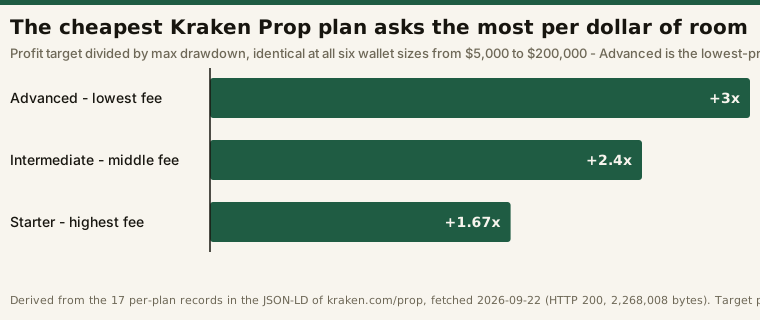
The ratio that matters is profit target divided by drawdown room — how much you must make per dollar of rope you are given. Across all seventeen plans it takes exactly three values, and they line up backwards against price:
| Plan | Profit target | Max drawdown | Target per $1 of drawdown | Fee on a $5,000 wallet |
|---|---|---|---|---|
| Advanced | 9% | 3% | 3.00x | $20 |
| Intermediate | 12% | 5% | 2.40x | $33 |
| Starter | 10% | 6% | 1.67x | $45 |
Two things fall out of that table, and both hold at every wallet size because the percentages are identical at all six.
The cheapest ticket buys the tightest rope. Advanced is the lowest fee on every wallet and gives 3% of drawdown against a 9% target; Starter is the highest fee and gives 6% against 10%. The $25 difference on a $5,000 wallet is not buying less product — it is buying twice the room to be wrong.
The ladder is not ordered by difficulty at all. The mid-priced Intermediate plan carries the highest profit target of the three at 12%, above both the cheapest plan’s 9% and the dearest plan’s 10%. Anyone reading the price list as a difficulty slider gets the middle rung exactly wrong.
The fee is not flat against the capital it buys
One more thing the ladder hides. As a percentage of the wallet it unlocks, the evaluation fee moves by a factor of nearly three:
| Cheapest per dollar of wallet | Dearest per dollar of wallet | |
|---|---|---|
| Plan | Advanced, $100,000 and $200,000 | Starter, $5,000 |
| Fee | $330 / $660 | $45 |
| As a share of the wallet | 0.33% | 0.90% |
The small Starter ticket is the most expensive entry in the matrix per dollar of capital, and the two largest Advanced plans are the least. That is the opposite of the volume discount most price ladders imply, and it is visible only once you divide.
The other split in the ladder — every plan carrying a second, higher price for the 90% end of its profit share — is a separate finding with its own home, covered in one broker built a door for AI agents, the other a wall.
The two numbers that decide whether the target is reachable
Here is the gap, and it is why a fee matrix alone cannot tell you whether a plan is worth buying. The page specifies max daily loss to the dollar across seventeen plans. Scanned this session with <script> and <style> stripped first — the raw HTML produces false positives from embedded JSON, which is why the strip matters — its 14,782 characters of visible text return zero hits for commission, funding, margin funding, 0.04%, 4 bps and 00:30. That negative result was already re-verified for a sixth consecutive session on 18 September; today’s fetch makes it seven.
So the page gives you the target and the drawdown but not what stands between them, and that matters more than it sounds: leverage is listed at “Up to 5x”, and trading costs scale with notional rather than wallet size. The arithmetic:
# Illustrative — NOT Kraken's rates. The page publishes no Prop trading cost,
# so `cost_bps` is a placeholder for whatever you verify before buying.
wallet, target = 5_000, 450        # $5,000 Advanced plan, read from the page
notional  = wallet * 5             # "Up to 5x" leverage, full size
cost_bps  = 4                      # per side, PLACEHOLDER — not a Kraken figure
per_trip  = notional * 2 * cost_bps / 10_000     # -> $20.00 a round trip

target / per_trip                  # -> 22.5 round trips consume the entire target
Stated as a rule so the numbers mean something: full 5x notional on every trip, a flat cost per side, slippage and financing ignored, on the $5,000 Advanced plan’s published $450 target. On those assumptions:
| Round trips at full size | Cost at 4 bps/side | Share of the $450 target |
|---|---|---|
| 5 | $100 | 22% |
| 10 | $200 | 44% |
| 20 | $400 | 89% |
| 23 | $460 | 102% |
Change the placeholder and the whole table moves — at 2 bps a side it takes 45 round trips to eat the target, at 8 bps it takes 11. That sensitivity is the point, and it is the same failure mode as an unverified fill assumption in a backtest: the input nobody publishes is the one that moves the result. A cost input you cannot read off the page swings the number of trades available to you by a factor of four, and it is the input the page omits.
The second omission is sharper: the max daily loss is a percentage, but the page never states when the day starts. A 3% daily limit with an unknown reset boundary is not a fully specified rule — and it is the rule that closes the wallet.
What Kraken says in its own words
Read live on 22 September 2026, and worth reading before the price list:
“This evaluation program is intentionally rigorous and designed to verify a trader’s risk-management skill and strategy discipline before any proprietary capital is allocated by Payward Oceanic Ltd. Most applicants do not pass on their first attempt and there is no guarantee that your performance will improve or that you will pass any future evaluations.”
And on what happens when a limit is breached: “the evaluation wallet will be closed. You don’t owe any additional funds and you can buy a new evaluation at any time. The evaluation fee is non-refundable.” Fees are described as “non-refundable for each attempt once trading begins, regardless of outcome.”
The evaluation is described as “a simulated trading environment that reflects live market conditions” and the fee as “your only financial risk” — both plainly stated on the free page, which is the same pattern we found across the prop-firm category generally.
One thing the page still does not say — open on a ninth consecutive check as of 18 September, and unchanged in today’s fetch: whether the funded wallet trades live capital or continues to simulate against it. “Kraken capital” describes whose money is at stake, not whether any of it reaches a market.
A purchase-linked sweepstakes that ran on this page through mid-September, advertised as ending 22 September, is gone from today’s fetch — a reminder that anything you read about a Kraken Prop promotion needs a date attached to it.
What this page is not
Not a review of the trading experience. This desk has logged zero evaluation sessions against its own ten-session publication bar, so nothing above describes what the product is like to use, and no account figures appear anywhere in it.
Not a verdict, and not permanent. Nothing here recommends or discourages a purchase; it puts the matrix, the ratio structure and the omissions in one place so the decision is made against numbers. Every figure is stamped to a fetch of kraken.com/prop on 22 September 2026 with its byte count and hash recorded, and no two fetches this trial has logged have returned the same byte count. Re-read the page before you pay.
Frequently asked questions
How much does a Kraken Prop evaluation cost?
From $20 for the $5,000 Advanced plan to $1,090 for the $200,000 Intermediate plan, across 17 plans on six wallet sizes, read from the page’s own structured data on 22 September 2026. Fees are non-refundable once trading begins. The full ladder is in the table above.
Which Kraken Prop plan is easiest to pass?
Cheapest and easiest are not the same plan. Measured as profit target per dollar of drawdown room, Starter is the loosest at 1.67x and also the most expensive on every wallet; Advanced is the tightest at 3.00x and the cheapest. Intermediate carries the highest profit target of the three at 12%. Whether any of them is passable depends on trading costs the page does not publish.
Is the Kraken Prop evaluation real money?
No. Kraken describes the evaluation as “a simulated trading environment that reflects live market conditions” and the evaluation fee as “your only financial risk.” Whether the funded stage trades live capital is not stated anywhere on the page — it was still unanswered on this desk’s ninth consecutive check on 18 September, and is unanswered in today’s fetch too.
Can I use a bot or an API on a Kraken Prop account?
Not through a supported interface. Kraken’s FAQ states that Prop “does not currently offer API access,” that this applies to evaluation and funded accounts alike, and that all orders are “placed manually through the trading interface.” What that means for anyone planning to automate is worked through in one broker built a door for AI agents, the other a wall.
What does Kraken Prop not tell you before you pay?
Three things, as of 22 September 2026: the trading cost applied to a Prop account, the time of day the max-daily-loss counter resets, and whether the funded wallet is live or simulated. The first two decide whether a published profit target is reachable; the page specifies drawdown to the dollar and omits all three.
Educational content, not financial advice. Nothing here recommends buying an evaluation or trading any asset. Everything inside a Kraken Prop evaluation is simulated by the product’s own design. This site has no affiliate relationship with Kraken and no earning link on this page; the desk paid full price for the evaluation it bought, and Kraken has not reviewed, seen or paid for any of this. All vendor figures are read from kraken.com/prop on 22 September 2026 and change without notice.