Agentic Trading and Crypto: One Broker Built a Door for AI Agents, the Other a Wall
Agentic trading now covers crypto at one broker via an MCP server and a ring-fenced account. At another, our probe found the eval wallet invisible.
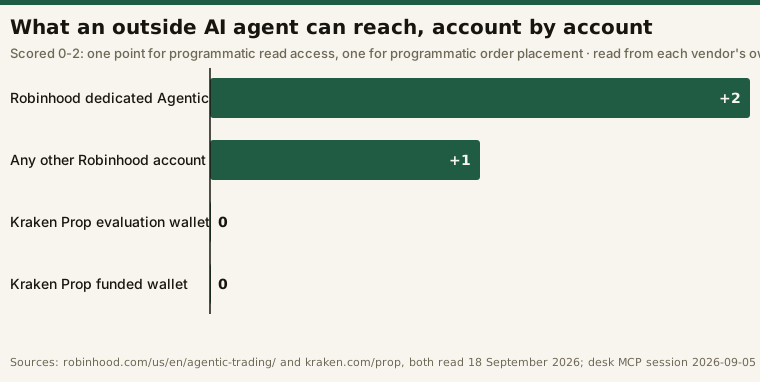
One broker now lets a third-party AI agent place orders in equities, options and crypto, through an MCP server pointed at a dedicated account you can disconnect from inside the app. Another sells a crypto prop evaluation whose own FAQ answers the API question in one word — no, for the funded account as well as the evaluation — and a read-only probe this desk ran across both of Kraken’s public APIs on 4 September 2026 returned nothing referencing the evaluation wallet at all.
This is not a review of which product is better — a brokerage account and a paid evaluation are different things sold to different people. What they share is a design decision neither marketing page frames as one: how much of the account an outside program may touch. This desk tested both products in the same week — the read-only Kraken API probe on 4 September 2026, a Robinhood MCP session on 5 September — and the two came back in opposite directions. Both answers are checkable on the vendors’ own pages before you pay anything. No account values, balances, positions or results appear below.
The two doors, side by side
| Robinhood Agentic Trading | Kraken Prop evaluation | |
|---|---|---|
| What you are buying | A brokerage account | A paid evaluation on one of six wallet sizes, $5,000 to $200,000, at evaluation fees of $20 to $1,090 for an 80% profit split — or $24.00 to $1,308.00 for 90% (full ladder below) |
| Programmatic access | “Market access for AI agents. Now available for equities, options, and crypto through Robinhood’s MCP server.” | “No, Kraken Prop does not currently offer API access.” |
| Where orders come from | The connected agent, into a dedicated account | “All orders on a Prop account are placed manually through the trading interface.” |
| Who carries the loss | You: “significant risk, including the possible loss of your entire investment” | “the evaluation fee is your only financial risk. Kraken covers any trading losses beyond that” |
| Source of the quoted wording | robinhood.com/us/en/agentic-trading/, read live 22 September 2026 | kraken.com/prop, read live 22 September 2026 (HTTP 200, 2,268,008 bytes) |
Every quoted cell is the vendor’s own wording, re-read on its own live page on 22 September 2026; the unquoted cells are our plain description of what the product is. The Kraken fetch carries a byte count because that page is under an open trial here and every fetch of it is logged; the Robinhood strings are a page read, and the dated first-hand Robinhood work on this page is the MCP session of 5 September 2026, further down. Both fee ranges come off Kraken’s own per-plan records in the same fetch; every plan carries two prices, and the gap between them is the subject of the ladder below.
The wall, measured rather than assumed
This desk bought a Kraken Prop evaluation on 4 September 2026 — the $20 Advanced plan on the $5,000 wallet — under a pre-committed trial protocol. Before any trading we probed Kraken’s public APIs read-only from the same account, to answer one question: can a program see the evaluation wallet at all?
# Illustrative — the shape of the read-only probe run on 2026-09-04.
# No orders were placed and no order endpoints were called.
spot    = post("/0/private/Balance",     key=SPOT_QUERY_KEY)   # 200 OK, real wallet returned
tb      = post("/0/private/TradeBalance", key=SPOT_QUERY_KEY)  # 200 OK
ext     = post("/0/private/ExtendedBalance", key=SPOT_QUERY_KEY)  # 404
futures = get("/derivatives/api/v3/accounts", key=FUTURES_KEY) # 200 OK, accounts list EMPTY

# The actual test: does anything in any response know the eval exists?
blob = json.dumps([spot, tb, futures]).lower()
[t for t in ("prop", "breakout", "eval", "funded", "challenge") if t in blob]
# -> []
The spot endpoints authenticated and answered normally. The futures endpoint authenticated and returned an empty account list. No object, field or string in any response referenced the evaluation. The $20 wallet the desk had paid for that day was, as far as both public Kraken APIs were concerned, not there.
We recorded that as an open question, because a probe finding nothing is weaker evidence than a vendor saying nothing exists. Six days later the vendor said it. The FAQ on kraken.com/prop, re-read live on 22 September 2026:
“Does Kraken Prop support API trading? No, Kraken Prop does not currently offer API access. This applies to both evaluation and funded accounts. All orders on a Prop account are placed manually through the trading interface.”
That is as clean as a negative result gets: probe and documentation agree, and the answer covers the funded phase too. It also settles a question of method — no supported API exists through which any desk could automate any part of a Kraken Prop account, so in-platform human observation is the only instrument a reviewer has, not a quirk of how we run our trial.
The wall is technical, not contractual
A missing API is easy to read as rule enforcement. Here it is not. Breakout — the firm Kraken acquired, whose help centre still carries the evaluation rules — publishes twelve prohibited practices for evaluation accounts, captured verbatim on 4 September 2026. It prohibits latency and error exploitation, insider information, front-running, off-the-shelf pass-the-evaluation services, changing strategy after funding, demo-account arbitrage, copied trades and signal-following, account sharing, and cross-account hedging. Automation, bots and API use are not on it.
So the constraint is an engineering one. The rules do not forbid pointing a program at the evaluation; there is no interface to point it at. Those facts have different lifespans.
One detail from the same list answers a question buyers ask constantly: prohibition eight refers to arbitrage involving your demo account, the firm confirming in its own rules that the evaluation is a demo — which matches what firms in this category say about themselves generally.
One ticket, two prices: what the $20 actually buys
One last thing about the $20 on that ticket: it is half of its own plan record. Every plan carries
the profit-share string “80%–90%” (read live on 22 September 2026) and two separate prices — one labelled Evaluation fee, one
labelled For 90% profit split. On the $5,000 Starter plan those read $45 and $54.00. Both numbers
in every cell below come off Kraken’s own per-plan records, parsed 22 September 2026:
| Evaluation wallet | Starter fee (80% / 90% split) | Intermediate fee (80% / 90%) | Advanced fee (80% / 90%) |
|---|---|---|---|
| $5,000 | $45 / $54.00 | $33 / $39.60 | $20 / $24.00 |
| $10,000 | $85 / $102.00 | $65 / $78.00 | $40 / $48.00 |
| $25,000 | $215 / $258.00 | $150 / $180.00 | $95 / $114.00 |
| $50,000 | $400 / $480.00 | $280 / $336.00 | $180 / $216.00 |
| $100,000 | $800 / $960.00 | $545 / $654.00 | $330 / $396.00 |
| $200,000 | not listed | $1,090 / $1,308.00 | $660 / $792.00 |
The surcharge is flat everywhere. The rule behind that claim: take each plan as one whole
record — wallet size, profit share and both prices together, so two figures can never be paired
across neighbouring plans — then divide the second price by the first. The ladder is not scraped
off rendered text at all. The page embeds its own machine-readable copy, which is why any reader
can re-derive every number in the table above with curl and a JSON parser:
# Illustrative — the shape of the parse run against a live fetch of kraken.com/prop
# on 2026-09-22 (HTTP 200, 2,268,008 bytes,
# sha256 a9f3de3e8b37ea29c8b4f509e4ea958070780e32a8767441ede7a418e74a8f0f).
# 25 application/ld+json blocks -> 172 Dataset nodes, of which the complete
# per-plan records carry the fee and the 90%-split price in absolute dollars.
plans = [d for d in datasets if d["name"] == "Kraken Prop mobile plan details"]
len(plans)                                              # -> 17  (6 wallet sizes x 3 plans, less
                                                        #         Starter at $200,000, not offered)
{round(money(p.fee90) / money(p.fee), 6) for p in plans}  # -> {1.2}  one ratio, zero variance
That the structured data exists at all is the finding underneath the finding: the terms this product is usually reviewed after buying are published, to the dollar, before you buy.
Seventeen tiers, one ratio, no exceptions — so the headline price and the headline profit split are never available at the same time. Kraken’s own FAQ, read live on 22 September 2026, frames the ceiling as a single promise: “Kraken Prop lets you trade with up to $200,000 of Kraken capital and keep up to 90% of your profits.” That 90% end costs a flat 20% more than the advertised evaluation fee at every wallet size. The $20 ticket buys the 80% end of the plan’s own “80%–90%” string; $24.00 buys the 90% end.
Nor are the three plans one product at three prices. On the $5,000 wallet the cheapest, Advanced at $20, carries the tightest max drawdown — 3% against Starter’s 6% — alongside the lowest profit target, 9% against Starter’s 10%. Cheaper buys a narrower margin for error, not less product. The full seventeen-plan matrix, with every target and drawdown beside its fee, is priced out separately. Vendor fees move; re-read the page before you buy.
The door, and what “ring-fenced” turns out to mean
On 5 September 2026 this desk connected to Robinhood’s trading MCP server from its own terminal and ran read-only calls. The mechanics — what the server exposes, how authentication works — belong to a separate write-up. One finding belongs here, as the counterpart of the Kraken result.
Ring-fencing is a field on the account, not a promise in a policy document. The account listing the server returns carries a per-account flag: the dedicated Agentic account reads agentic_allowed: true, the owner’s ordinary margin account agentic_allowed: false. The separation is not a mode the agent is trusted to respect but a property the broker attaches to each account — and it reaches past order permission, since the agentic account also carried a lower options approval level than the main one.
The crypto expansion arrived the same way. There was no setting to switch on because there was nothing to switch: the agentic account already carried a linked crypto account number when we looked. The change had been made server-side, and the announcement email was notification of it rather than an invitation.
That is a different posture from bridge-style integrations, where a connector drives a logged-in desktop app and inherits whatever your own session can do. Here the permission band is set by the broker, per account, in a field. Webull draws the same line differently, across two separate servers rather than two accounts.
Read the risk language before the marketing
The same page carries a disclosure worth quoting to anyone excited by the idea:
“Robinhood does not control, supervise, monitor, recommend, or audit these AI agents. Once your data is shared with an AI provider of your choice, it leaves Robinhood’s security environment and is governed by that provider’s terms, not ours.”
And on the trading itself: “AI agents can make errors, misinterpret instructions, act on incomplete or outdated information, and may behave in unexpected ways.” The customer is responsible for monitoring.
Read alongside the account flag, the architecture is coherent: the broker bounds the blast radius, then says plainly that everything inside the boundary is your problem. Which is why the first thing to build around an agent is operational guardrails, not a strategy.
What neither vendor will tell you yet
Both pages have a hole, and the holes are opposite in character.
On Kraken’s side, the question our trial opened on day one was still open at the ninth check of the public page, logged 18 September 2026: the funded phase’s live-versus-simulated status is never stated. The FAQ is explicit that the evaluation happens in “a simulated trading environment that reflects live market conditions”, and says of the funded stage only that “you trade with Kraken capital instead of your own funds.” Whose money is at stake is not the same question as whether any of it reaches a market; the page answers the first and never addresses the second.
On Robinhood’s side the gap is the inverse — the account boundary is documented precisely, and what happens inside it is covered by risk disclosure rather than by mechanism. Whether a broker-enforced ceiling exists on what an agent can do between connecting and disconnecting has been answered confidently in third-party coverage and we could not verify it first-party, so we are not repeating those answers.
Frequently asked questions
Can an AI agent trade crypto at a broker today?
At Robinhood, yes, per the broker’s own page read live on 22 September 2026: “Market access for AI agents. Now available for equities, options, and crypto through Robinhood’s MCP server.” The agent trades in a separate account you fund for it. Whether it should is a different question, and the broker’s own disclosure — “significant risk, including the possible loss of your entire investment” — is where to begin.
Can I run a bot on a Kraken Prop evaluation?
Not through an API. Kraken’s FAQ states that Prop “does not currently offer API access”, that this applies to both evaluation and funded accounts, and that all orders are “placed manually through the trading interface.” Our 4 September 2026 probe found no reference to the evaluation wallet in any response from either public Kraken API.
Do prop firm rules ban automated trading?
Breakout’s list of twelve prohibited evaluation practices, captured on 4 September 2026, does not include bots, automation or API use. Here the obstacle is the absence of an interface, not a rule against using one. Rules differ by firm and change; read the current list on the firm’s own help pages before assuming either way.
Is the Robinhood agentic account separate from my main account?
The broker describes it as a dedicated account funded with “an amount reserved for your agent’s trades.” In our 5 September 2026 session the separation appeared as a per-account permission flag: the agentic account was marked as permitted for agent use, the ordinary margin account was not.
Is this page sponsored?
No. This site has no affiliate relationship with Robinhood or Kraken and carries no earning link on this page. The Kraken evaluation was bought at full price by this desk; neither company has reviewed, seen or paid for any of this.
Educational content, not financial advice; nothing here recommends buying any product or trading any asset. Connecting an AI agent to a funded brokerage account carries risk of total loss, as the broker’s own disclosure states. Our Kraken Prop evaluation is an open, incomplete trial, and everything inside an evaluation is simulated by the product’s own design.