Prop Firm Crackdown 2026: What's Actually Verified Before You Pay
The 2026 prop firm crackdown is thinner on documented fact than the headlines suggest. What holds up against primary sources, and what does not.
The “prop firm crackdown” of 2026 is much thinner as a regulatory event than the coverage suggests. Two things hold up against primary sources: the largest firms describe their accounts as simulated on their own public pages, and the flagship US enforcement action against a retail prop firm ended in a dismissal with prejudice and sanctions against the regulator. Most of the specific regulatory action being reported — named consultations, dated enforcement filings, sector statistics — could not be traced to a primary source at all.
This site has no affiliate relationship with any prop firm and no plans to have one, and nobody here has bought or run a challenge account. Every claim below is a source check, not a first-hand account of how these programs behave in use.
What is actually documented
The accounts are simulated, and the firms say so on their own sites
This is the single most useful thing a prospective challenge buyer can check, and it takes about ninety seconds per firm. Across three firms and two asset classes, the answer sits on a public page, free, before any fee is paid:
| Firm | Page the wording appears on | The vendor’s own words |
|---|---|---|
| FTMO | Trading Objectives | “All accounts we provide to our clients are demo accounts with fictitious funds and any trading is in a simulated environment only.” |
| FundedNext | CFD Challenge Terms | “All trading activity within the CFDs Challenge occurs exclusively within a simulated environment. No orders are executed in the live market, and no financial instruments are purchased, sold, or traded on behalf of the Customer.” |
| Topstep | Homepage | “The Trading Combine, Express Funded Accounts and Topstep Labs experiments are realistic simulations of trading under actual market conditions” |
None of that is a critic’s characterisation. It is three vendors describing their own product in language they chose — and a firm that states it plainly is doing the right thing, not being caught out. The finding is the pattern rather than any one disclosure: on every firm checked, “am I trading the firm’s capital?” was answerable before paying anything.
Whether that makes the product bad is a separate question — a skill-based competition with an entry fee and a prize is a legitimate thing to sell. But it changes what you are buying. It also means the fills you are graded on are produced by someone’s simulation, and a simulation’s assumptions are not neutral: our own options backtest fill assumptions work reversed the sign of a result on the fill convention alone, without changing a single entry or exit.
The regulator’s flagship prop-firm case collapsed — against the regulator
The case most often cited as proof that the CFTC is coming for prop firms is the action against Traders Global Group, the parent of My Forex Funds. It ended badly, and not for the firm.
In an order signed on 13 May 2025, Judge Edward S. Kiel of the District of New Jersey dismissed the CFTC’s complaint with prejudice and sanctioned the agency, following a Special Master’s finding that the agency had misled the court, including errors in a sworn declaration. Reporting on the outcome puts the fee award against the CFTC at over $3 million.
Anyone picturing 2026 as regulators steadily closing in should sit with that: the highest-profile enforcement action against a retail prop firm to date did not establish that the model is unlawful.
What could not be verified
Several of the most-repeated claims on this topic did not survive contact with a primary source.
- The “80 to 100 firms collapsed” count. It circulates everywhere and traces to a July 2026 Forbes feature by Boaz Sobrado on the funded-trader industry. That article returns HTTP 403 to our fetcher, and no retrievable source we found carries the figure or the date window attached to it. It is not repeated here as fact. The same applies to the $10B sector size taken from that feature’s own headline: no regulator, exchange or audited filing publishes a sector total for this business, so treat it as a magazine headline’s framing, which is what it is.
- A CFTC public consultation on futures-prop oversight, closing 30 November 2026. This appears across multiple sites. In the CFTC’s own materials, the open request for comment we could locate concerns direct clearing of derivatives by retail participants, comments due 2 February 2026 — a related retail-access question, not a consultation on the prop-firm model.
- SEC enforcement actions filed in August 2026 against prop firms for presenting simulated trading as live. Not locatable in the SEC’s own press releases or litigation releases. That does not prove they do not exist, but nobody should repeat the claim as fact, including us.
- Precise industry statistics — annual challenge-purchase counts, average fee, sector revenue growth. These circulate widely and trace back to commercial blogs inside the prop-firm affiliate ecosystem.
- FCA sector guidance. A search of the FCA’s own site surfaced no publication specifically addressing funded-trader or fee-for-evaluation models. That search was not exhaustive, so read it as “not found,” not “does not exist.”
A pattern worth naming: the sites making the most confident regulatory claims are frequently the same sites carrying affiliate links to the firms in question. A crackdown narrative creates urgency and positions the page as the guide to the “safe” firms — a commercial incentive to overstate, and it appears to be operating.
The verification lesson: one claim, checked at the source
Multiple prop-firm review sites report that FTMO reduced its first-phase profit target from 10% to 8% in 2026. FTMO’s own Trading Objectives page does not agree.
| Claim (third-party review sites) | FTMO’s own Trading Objectives page |
|---|---|
| First-phase profit target was cut to 8% in 2026 | 1-Step Challenge profit target is “10% of the Initial Simulated Capital” |
| The same claim, carried across to the two-phase product | 2-Step Challenge is 10% for the Challenge phase and 5% for Verification |
The most-repeated figure is the wrong one. Here is the rest of that page, since the profit target is its least binding objective:
| Objective (as % of Initial Simulated Capital) | 1-Step Challenge | 2-Step Challenge |
|---|---|---|
| Profit target | 10% | 10% Challenge / 5% Verification |
| Maximum daily loss | 3% | 5% |
| Maximum loss | 10% | 10% |
| How the maximum loss behaves | End-of-day trailing — “can only increase, but never decrease” | Static |
| Minimum trading days | — | “at least 4 Trading Days” |
| Profit target on the funded FTMO Account | None | None |
A dash means the page did not state that objective for that path.
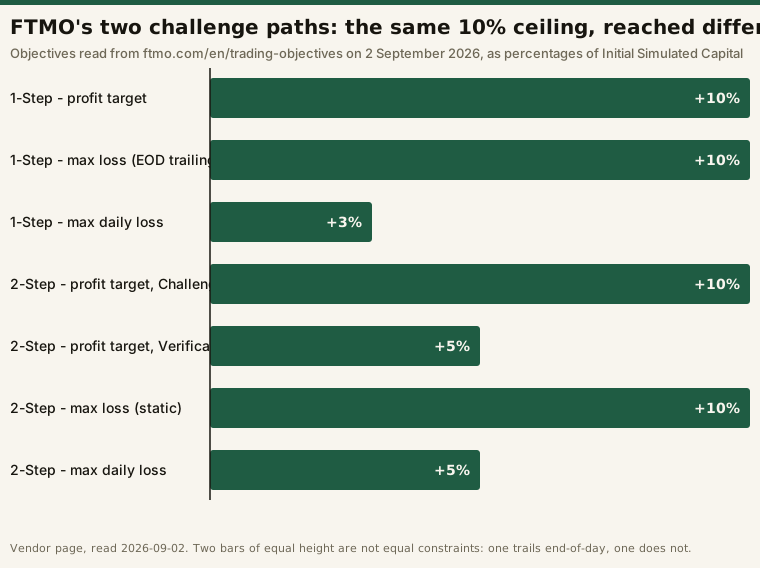
Two 10% bars, two different constraints
The two 10% maximum-loss bars are the same height and are not the same rule. One is an end-of-day trailing limit whose floor ratchets up with your equity and never comes back down; the other is fixed at the starting balance. The difference is arithmetic, and it is easier to read as code than as prose:
# Illustrative only. Applies the two published FTMO maximum-loss rules to the same
# arbitrary end-of-day equity path, on 100,000 units of Initial Simulated Capital.
START, MAX_LOSS = 100_000, 0.10
eod_equity = [100_000, 104_000, 107_000, 103_000]   # arbitrary, not a projection

static_floor = START * (1 - MAX_LOSS)               # 90,000, fixed forever
print(static_floor)                                 # -> 90000

# End-of-day trailing: the floor tracks the high-water equity and, per the page,
# "can only increase, but never decrease".
high_water = START
for eq in eod_equity:
    high_water = max(high_water, eq)
trailing_floor = high_water * (1 - MAX_LOSS)        # -> 96300
print(trailing_floor)
Same headline percentage, same equity path, and the floor a trader can be stopped out at differs by 6,300 units — because the trailing version converted a good week into a tighter constraint. A trader reading only the headline percentage cannot tell the two apart. Nobody here has bought or run a challenge account, so this page cannot tell you how that ratchet feels in practice — only what the published rule does arithmetically. That is why this page recommends nothing.
Those figures are the ones on the vendor’s page as at the date in the sources note, and they can change without anyone updating the blog post you found them in — including this one. The point is not the numbers: a rule you can only quote from a review site is a rule nobody has checked, and in a category where the rules decide whether the fee buys anything, that is not a detail. Same discipline as every tool crossing this desk under our trial protocol.
Questions worth answering before you pay a fee
Not advice on whether to do it — that is yours. Just the questions with checkable answers, all settleable from the firm’s own documents before any money moves:
- Is the funded account simulated or live? Read the firm’s own terms, not its marketing. All three firms above answer it on a public page.
- What exactly are the loss limits, and are they static or trailing? As the code above shows, a trailing end-of-day drawdown and a static drawdown at the same headline percentage are very different constraints.
- What are the payout terms and the conditions on a first payout? This is where a fee-for-evaluation model realises or does not realise its promise.
- What happens on a minor rule breach — warning or termination? Get it from the written terms.
- Where is the firm domiciled, and who, if anyone, regulates it? Neither is implied by the marketing, and the answer determines what recourse exists if the firm stops paying.
- Can you afford the fee as a total loss? On the vendors’ own descriptions of the accounts, it is closer to the entry price of a skill competition.
One firm answers most of these in machine-readable form before you pay: the full seventeen-plan ladder, every fee against its target and drawdown, is priced out in our Kraken Prop desk test.
Frequently asked questions
Are prop firms being regulated in 2026?
They are under discussion and under commercial pressure, but the specific consultations and enforcement actions widely reported this year could not be verified against primary sources. The one flagship case that did reach a US court ended in dismissal with prejudice and sanctions against the regulator.
Does “funded” mean I trade the firm’s money?
Not necessarily, and often not. FTMO, FundedNext and Topstep all describe their accounts as simulated on their own public pages, in the wording quoted above. Check the specific firm’s terms, since they differ.
Did 80 to 100 prop firms really collapse?
That figure is not verifiable from here. It traces to a Forbes feature that returns HTTP 403 to our fetcher, and no retrievable source we found carries it. No regulator, exchange or audited filing publishes a firm count or a sector total for this business, so every headline number in this category is an estimate of unknown provenance until someone shows the underlying list.
What is the difference between a trailing and a static drawdown limit?
A static limit is fixed at the account’s starting balance. A trailing limit moves up as equity makes new highs — FTMO’s 1-Step page describes its end-of-day version as one that “can only increase, but never decrease” — so profit raises the floor you can be stopped out at. Same headline percentage, less room.
Does the end of the pattern day trader rule change the case for a prop firm?
It removes one of the more common reasons given for paying an evaluation fee. FINRA eliminated the $25,000 minimum equity requirement in 2026 and replaced it with an intraday margin standard, so “get around the $25k minimum” is no longer a live argument — though the 18-month phase-in means your own broker may not have moved yet.
Do you recommend a prop firm?
No. This site holds no affiliate relationship with any firm in this category, has never run a challenge account, and is not recommending or warning against any of them. This page is about how to check claims, which is the part that transfers no matter which firm you are looking at — the same reason we publish how we validate anything before trusting it.
Vendor pages cited above, last checked 3 September 2026: FTMO’s Trading Objectives page (ftmo.com/en/trading-objectives), FundedNext’s CFD Challenge Terms (fundednext.com/cfd-challenge-terms) and topstep.com. Other sources: the 13 May 2025 dismissal order in the CFTC’s action against Traders Global Group and reporting on it; CFTC and SEC newsroom materials; FCA publications search. The Forbes feature “I Want To Stay In Simulation — Inside The $10B Funded-Trader Boom” (Boaz Sobrado, 22 July 2026) is referenced only for its existence and headline framing — it returns HTTP 403 to our fetcher, so no figure is carried from it. Vendor figures reflect the date stated only.
This is educational content, not financial, legal or tax advice. Nothing here is a recommendation to purchase or avoid any firm’s product, and no claim is made about the legality of any business model.